
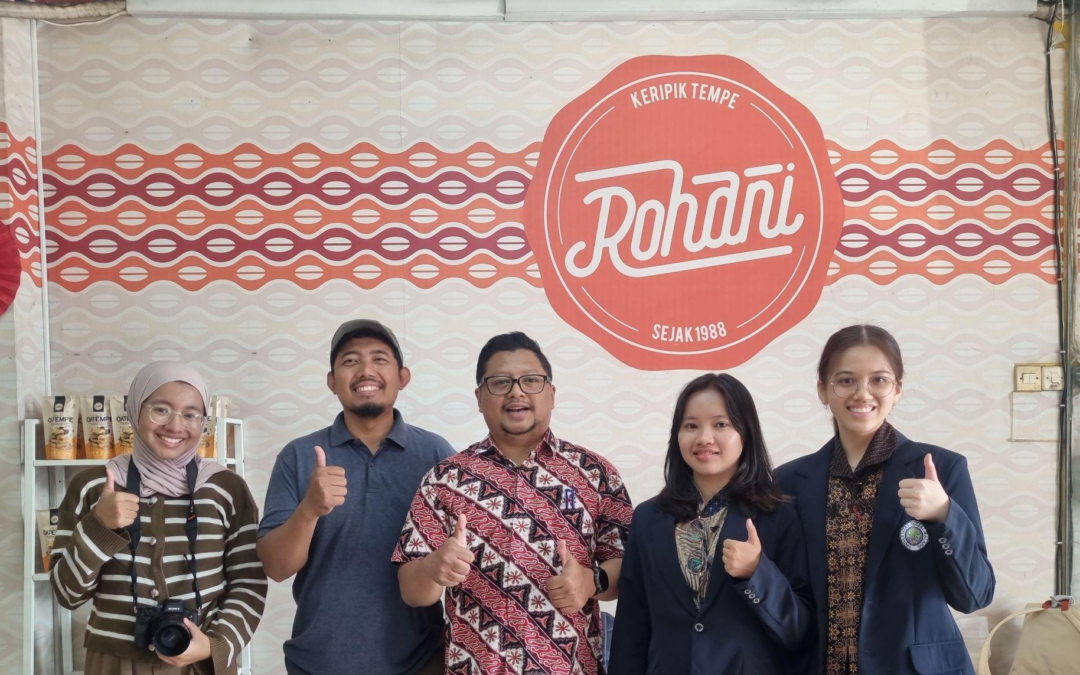
Malang, April 14, 2026 – Universitas Negeri Malang (UM), through Community Service activities, promotes the downstreaming of local tempeh through the development of tempeh flour and product diversification bakery and pastry based smart packaging sustainable. The program, titled “Realizing Asta Cita: Downstreaming of Local Tempeh through the Development of Tempeh Flour and Products Bakery and Pastry Innovation-based Smart Packaging Sustainable” This was carried out in collaboration with the Rohani Tempe Chips MSME at Jalan Tumenggung Suryo No. 90, Malang City.
This activity, which took place from April 14 to December 24, 2026, was led by Prof. Ani Wilujeng Suryani, Ph.D., CA by involving Arzendy Berlian Sabrina, S.Pd., M.Par., Tatas Ridho Nugroho, S.Pd., M.Pd., M.Ak., along with students Fortunata Fatria and Gracia Natali Adonia. The program involves partner leaders, production workers, warehouse staff, and store personnel as direct beneficiaries.
This program is designed to increase the added value of local tempeh through the development of tempeh flour as a raw material intermediate, while also producing derivative products in the form of bakery and pastry. The approach is integrated with improving production process efficiency, quality control, drafting standard operating procedures (SOPs), as well as developing a more informative and sustainable packaging system.
In implementation, the partners receive training and mentoring on the use of various production equipment, such as dehydrator, grinder, mixer, proofreader, and oven. Assistance also includes formulation of products based on tempeh flour, application quality control, as well as the use of smart packaging which is equipped with a freshness indicator and QR code to support the delivery of information and product traceability.
The results of the implementation show an increase in the production capacity of tempeh flour from about 5 kg to 10 kg per day. On the other hand, production lead time can be reduced from approximately 8 hours to 6 hours per batch. The shelf life estimation of the product also increased from 60 days to 95 days, while the partners' empowerment level increased from the score 2.44 to 4.00.
Head of the implementing team, Prof. Ani Wilujeng Suryani, Ph.D., CA, stated that tempeh downstreaming is one of the efforts to increase the economic value of local food through innovation and strengthening the capacity of MSMEs.
“Through downstream processing of local tempeh, we hope that partners will not only have better production capacity, but also be able to produce innovative products with higher added value and competitiveness.”
This program contributes to SDG 8 (Decent Work and Economic Growth) through the capacity building and business development of MSMEs, SDG 9 (Industry, Innovation, and Infrastructure) through the application of food processing technology and innovation, and SDG 12 (Responsible Consumption and Production) through production process efficiency, strengthening quality control, and implementation smart packaging sustainable.

Going forward, the program is directed toward continuing to strengthen partners' independence in technology operation, the implementation of SOPs and quality control, the development of product variants, and market expansion. The innovation of tempeh flour and its derivative products is expected to become a sustainable business line while opening up opportunities for the development of similar models for other food MSMEs. Through this activity, the university not only promotes the implementation of technology-based innovation, but also strengthens the connection among higher education institutions, MSMEs, and local economic development. The downstreaming of tempeh is expected to be part of the effort to create innovative, value-added food products that support more sustainable production practices.